
Dental implant care is the combination of daily cleaning at home and regular professional check-ups that keeps the gum and bone around an implant healthy. Implants do not decay; however, the tissues around them are affected by bacterial plaque, just as they are around natural teeth. For this reason, the long-term success of implant treatment depends to a large extent on the care that follows it.
Why is implant care important?
Implant care is the main way to prevent peri-implant diseases. A dental implant is a titanium or zirconia structure placed in the jawbone that supports a prosthesis. Unlike a natural tooth, an implant is not surrounded by the network of periodontal fibers that attaches a tooth to the bone. This structural difference can allow plaque-induced inflammation to progress more quickly within the tissues.
The S3-level clinical practice guideline published by the European Federation of Periodontology (EFP) in 2023 emphasizes that the prevention of peri-implant diseases should begin from the moment an implant is planned. According to the guideline, not attending a regular supportive care program is an important risk indicator for peri-implant diseases.
In short, whether an implant stays healthy in the mouth for many years depends as much on the care habits that follow as on the surgery itself. This is why the maintenance program should be discussed from the outset when dental implant treatment is being planned.
How should you care for implants at home every day?
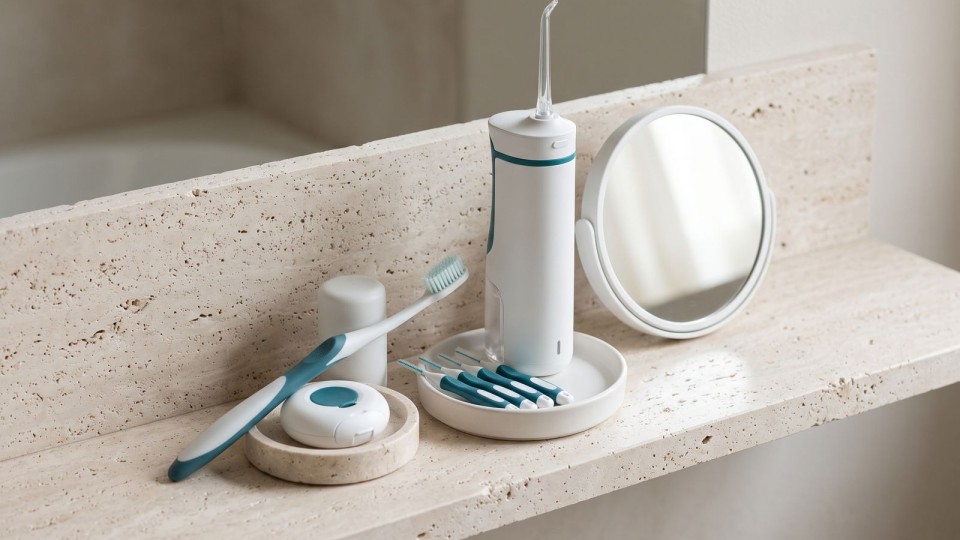
Home care for implants consists of brushing twice a day, cleaning between the implant and neighboring teeth every day, and using special tools that reach under the prosthesis. The basic steps are:
- Brushing: Brush twice a day for about two minutes with a soft-bristled manual or electric toothbrush. Aim the brush at the line where the implant meets the gum.
- Interdental brush: Use an interdental brush of the right size in the space between the implant and the neighboring tooth. The right size is a brush that enters the space without forcing and gives a slight sense of friction; it is recommended that you choose the size together with your dentist.
- Implant-specific floss: Thick floss with a spongy section is useful for cleaning the neck of the implant and the area under bridges.
- Single-tuft brush: Can be used for targeted cleaning around implants in the back of the mouth and in hard-to-reach areas.
- Water flosser: A helpful tool, especially for cleaning under fixed bridges and full-arch prostheses; however, it does not replace brushing and interdental cleaning.
With fixed full-arch prostheses, for example All-on-4 and All-on-6 restorations, cleaning under the surface of the prosthesis that faces the gum is especially important. Plaque that builds up in this area often goes unnoticed. It is helpful to learn hands-on, during your check-up appointments, which tools to use and how.
For brushing and interdental techniques, you can also read our Guide to Proper Toothbrushing and Interdental Cleaning.
How often should professional implant maintenance be done?
How often professional implant maintenance is needed is determined by each person's risk profile; studies support a check-up interval of at least every 5–6 months for the prevention of peri-implant diseases. For people with a history of periodontitis, who smoke, or who have difficulty with plaque control, this interval may be shortened.
A supportive implant maintenance appointment usually includes:
- Assessment of the gum around the implant for bleeding, swelling and discharge,
- Measurement of pocket depths with a delicate probe and comparison with previous records,
- X-rays, when considered necessary, to monitor the bone level,
- Removal of plaque and tartar with special instruments that will not damage the implant surface,
- Checking the fit of the prosthesis, the screws and the biting forces,
- Reviewing the cleaning tools and technique you use at home.
If you also have natural teeth, their periodontal health is assessed at the same appointment. This is because active gum disease elsewhere in the mouth is also a risk for the tissues around the implant.
What are peri-implant mucositis and peri-implantitis?
Peri-implant mucositis is inflammation of the soft tissue around an implant without bone loss; peri-implantitis is the condition in which the inflammation progresses to the bone supporting the implant and leads to bone loss. The relationship between the two is similar to the relationship between gingivitis and periodontitis around natural teeth.
Peri-implant mucositis usually shows itself as bleeding during brushing, redness and mild swelling. At this stage, the inflammation can often be reversed by improving plaque control and with professional cleaning. Some cases of untreated mucositis may progress to peri-implantitis over time.
In peri-implantitis, pocket depth increases, bleeding or pus may be seen on probing, and bone loss is visible on X-rays. In the early stages there is often no noticeable pain; for this reason, regular check-ups are decisive for diagnosis. Depending on how far the disease has progressed, treatment can range from non-surgical cleaning to surgical procedures. For details, see our peri-implantitis treatment page.
Bleeding around an implant during brushing may be the first sign of a problem. Intervention at the peri-implant mucositis stage can help bring the inflammation under control before bone loss develops. If the bleeding does not stop within a few days, see your dentist without waiting for your scheduled check-up.
What factors affect implant health?
The main factors affecting implant health are a history of periodontitis, inadequate plaque control, smoking, uncontrolled diabetes and not attending a regular maintenance program. The EFP guideline also lists these factors among the risk indicators for peri-implant diseases.
- History of periodontitis: People who have had gum disease in the past have a higher risk of peri-implant disease. For this reason, gum disease treatment should be completed before implant placement.
- Smoking: It has a negative effect on tissue healing and the immune response, and it can also mask warning signs such as bleeding. You can read our article Smoking and Gum Disease on this topic.
- Diabetes: When blood sugar is not well controlled, susceptibility to inflammation may increase.
- Prosthesis design: Prosthesis shapes that make cleaning difficult can make it easier for plaque to accumulate.
- Soft tissue characteristics: In areas where the gum around the implant is thin or mobile, brushing can become sensitive and plaque control more difficult.
- Clenching and grinding: These can place excessive load on the prosthesis and its components; if the dentist considers it necessary, a night guard may be recommended.
When planning implants, periodontist Dr. Nadin Gemrekoğlu, DDS, PhD, places emphasis on assessing these risk factors before treatment and on setting an individualized maintenance program.
When should you see a dentist?
If you notice any of the following around your implant, see your dentist without waiting for your scheduled check-up:
- Bleeding during brushing or interdental cleaning that lasts more than a few days,
- Redness, swelling or pus around the implant,
- Gum recession or the metal part of the implant becoming visible,
- A bad taste in the mouth or persistent bad breath,
- Movement of the prosthesis, a feeling that a screw has loosened, or discomfort when biting,
- Pain or tenderness in the implant area.
These signs do not always mean there is a serious problem; however, the cause needs to be identified through an examination and any necessary tests. To book a check-up, you can reach us through our contact page.