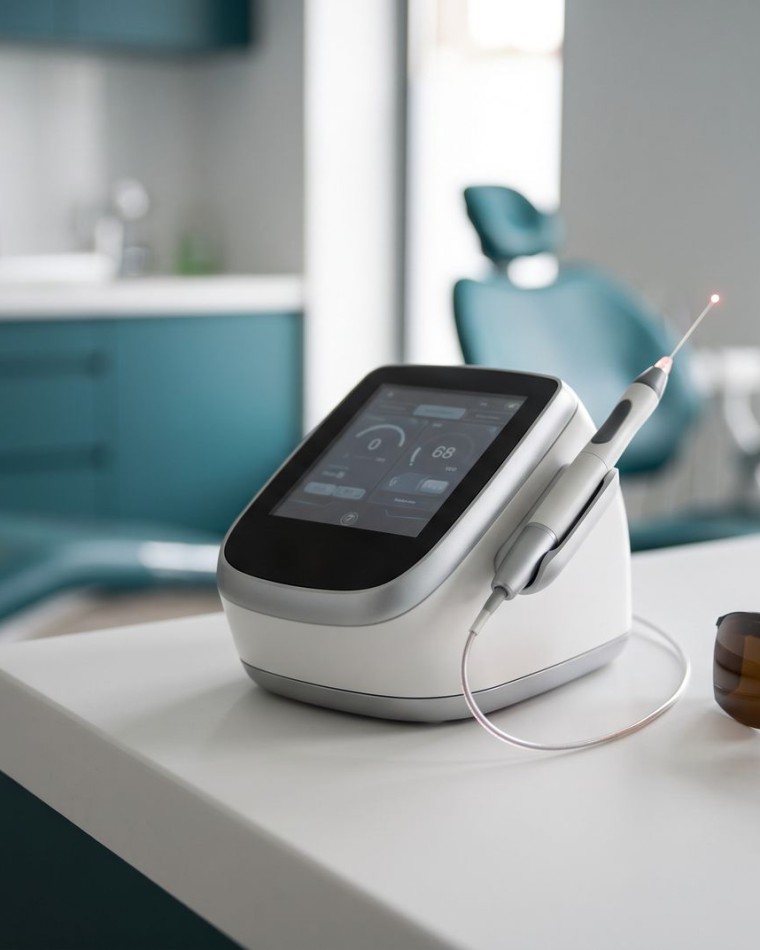
Laser gum treatment is the use of devices that produce light energy at specific wavelengths as an aid in gum treatments. A laser is a tool that may be chosen for gum contouring, certain soft tissue procedures and applications inside periodontal pockets. However, current scientific evidence shows that in the treatment of periodontitis, a laser does not replace mechanical cleaning and is not a sufficient solution on its own.
What is a laser in dentistry?
A laser is a device that produces concentrated light of a single wavelength. Lasers used in dentistry interact with tissues in different ways depending on their wavelength. Diode and Nd:YAG lasers are used mainly on soft tissues, while Er:YAG and Er,Cr:YSGG lasers can be used on both soft and hard tissues. Which laser is chosen for which purpose depends on the type of procedure and the clinician's clinical assessment.
When laser light reaches the tissue, it is absorbed, and a significant part of its energy is converted into heat. This heat cuts or vaporizes the tissue or seals small blood vessels. The depth of the effect depends on the wavelength, the power, the duration of application and the water and pigment content of the tissue. For this reason, the same device can produce very different effects at different settings.
Photodynamic therapy is a separate method in which a light-sensitive substance is used together with low-power light, and it is sometimes mentioned under the same heading as laser treatments.
When is a laser used in gum treatment?
- Soft tissue procedures such as gum contouring (gingivectomy, gingivoplasty)
- Correction of gum overgrowth related to medication use or inflammation
- Lip or tongue tie procedures (frenectomy)
- Removal of dark pigmentation of the gums (depigmentation)
- As an adjunct inside periodontal pockets in selected cases, in addition to mechanical cleaning
Most of these procedures can also be performed, where appropriate, with conventional methods such as a scalpel or electrosurgery. Whether a laser is chosen is decided by considering the type of procedure, the characteristics of the tissue and the person's general health together.
For information on gum procedures performed for aesthetic purposes, you can also visit our gum aesthetics page.
Is a laser sufficient for treating periodontitis?
No. The foundation of periodontitis treatment is the mechanical removal of bacterial plaque and tartar from the pockets and root surfaces below the gumline. A laser does not replace this cleaning; however, it may be considered as an adjunct that accompanies it.
After reviewing the available studies, the 2020 S3 clinical practice guideline of the European Federation of Periodontology (EFP) does not recommend the routine use of lasers in addition to subgingival cleaning. According to the experts who developed the guideline, the additional benefit of lasers has not been consistently demonstrated in studies. The same guideline also does not recommend the routine use of photodynamic therapy as an adjunct.
This does not mean that lasers are of no use at all. It does show, however, that if a laser is to be used in periodontitis, it should be planned not as a substitute for the core treatment, but in selected cases where there is a justification and in addition to mechanical therapy. It is therefore more accurate to think of “laser gum treatment” as part of a process that includes scaling and root planing and regular oral care.
The cause of gum disease is the bacterial plaque and tartar that stick to the root surface. Unless these are removed and regular plaque control is maintained at home, no device, including a laser, can keep the inflammation under control on its own.
What are the possible advantages of a laser?
In soft tissue procedures, a laser may offer some practical benefits. Because the laser seals small blood vessels as it cuts the tissue, there may be less bleeding during the procedure and the working area may be seen more clearly. In some procedures, the need for stitches may be reduced. Although some patients report greater comfort after the procedure, the results of studies on this topic vary. Some studies have suggested that lasers may affect wound healing or bacterial load; however, there is no consensus on whether these findings make a clinically meaningful difference.
These advantages do not apply to every procedure or every patient. Where appropriate, the same procedure can be performed in a similar way with conventional surgical instruments. Which method is chosen is planned individually after the examination and any necessary tests; results vary from person to person.
What are the limitations and risks of lasers?
- Level of evidence: An additional benefit over mechanical cleaning in the treatment of periodontitis has not been consistently demonstrated.
- Heat effect: When used with inappropriate settings, heat-related damage to the gums, root surface or bone may occur.
- Eye safety: During the procedure, the patient and the clinical team need to wear protective eyewear suitable for the laser.
- Medical assessment: The medications you take and your general health are assessed before every procedure; any suspicious lesion in the mouth should be examined for diagnosis before it is removed with a laser.
- Unrealistic expectations: A laser does not remove the need for regular oral care and maintenance visits.
Whether laser use is safe and fit for purpose depends on choosing the right indication, the right device and the right settings.
How is laser treatment performed?
First, a diagnosis is made with a periodontal examination and the necessary radiographs. This assessment determines whether using a laser would really make a contribution in your case. If gum disease is present, the core periodontal treatment is planned first. It is important to share the medications you take and your general health with your clinician before the procedure.
On the day of the procedure, the patient and the clinical team wear protective eyewear. Topical or local anesthesia is applied depending on the type of procedure; the aim is for you not to feel pain during the procedure. For applications inside periodontal pockets, the laser is used together with or after cleaning with hand instruments and ultrasonic devices. Soft tissue procedures such as gum contouring are usually completed in a single session.
How many sessions does it take?
The number of sessions depends on the purpose for which the laser is used. Soft tissue procedures such as gum contouring, frenectomy or depigmentation are usually completed in a single session; for larger areas, the procedure may be divided into more than one session. In periodontal treatment, the laser is considered part of a stepwise treatment plan: oral hygiene instruction and non-surgical periodontal therapy come first, followed by a re-evaluation a few weeks later. Whether a laser will be part of this process, and at what stage it will be used, is planned individually. Once treatment is complete, regular maintenance visits continue.
What should I keep in mind after treatment?
- Avoid very hot, spicy and hard foods on the first day.
- A whitish healing layer may appear at the treated site; this is usually a normal part of healing, so do not try to scrape it off.
- Continue brushing as your clinician recommends; be gentle around the treated area.
- Avoid touching the treated area with your tongue or fingers.
- Smoking can delay healing; if possible, do not smoke in the period after the procedure.
- If you have increasing pain, swelling or fever, contact your clinician.
If a laser was used as part of periodontal treatment, what mainly determines whether the result is maintained is regular plaque control at home and maintenance visits. If your gums keep bleeding, you can read about the possible causes in our article why do gums bleed?