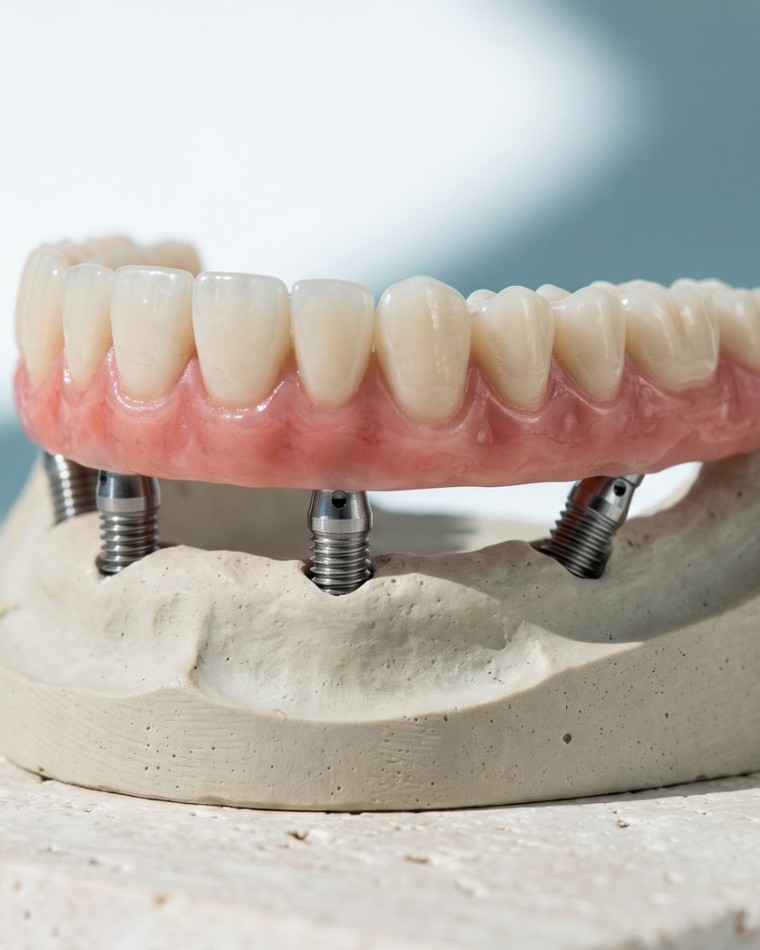
All-on-4 and All-on-6 are treatment approaches in which a one-piece fixed prosthesis is placed on four or six implants, respectively, in a jaw with no teeth or when all the teeth need to be extracted. The aim is to achieve a row of teeth that stays fixed in place and supports chewing function, instead of a removable denture.
What are All-on-4 and All-on-6?
All-on-4 is a method in which a fixed prosthesis carrying all the teeth in one jaw is placed on four implants. In this method, the two front implants are placed upright, while the two back implants are placed at a specific angle. Angled placement keeps the implants away from the sinus cavity in the upper jaw and the nerve canal in the lower jaw, allowing the available bone to be used more efficiently.
All-on-6 follows the same principle, with the prosthesis supported by six implants. The prosthesis is not taken out by the patient; it is screwed onto the implants and can be removed only by the dentist when needed.
Conventional complete dentures stay in place by resting on the palate and gums; over time, they can loosen as the bone beneath them resorbs. Implant-supported fixed prostheses, in contrast, transfer forces to the bone through the implants and can be designed without covering the palate in the upper jaw. These features may help reduce complaints about the prosthesis moving during chewing and speaking.
What is the difference between All-on-4 and All-on-6?
The main difference is the number of implants supporting the prosthesis. Six implants distribute chewing forces over more points and may help maintain support for the prosthesis if a problem develops with one of the implants. However, placing six implants requires sufficient bone over a wider area of the jaw.
The four-implant approach, on the other hand, may reduce the need for additional bone grafting in some situations where bone volume is limited. Which approach is appropriate depends on the amount of bone, the jaw structure, the condition of the teeth in the opposing jaw and biting force.
Who are All-on-4 and All-on-6 suitable for?
These approaches are generally considered in the following situations:
- People who have no teeth left in one or both jaws
- Patients whose remaining teeth have been found to be unsalvageable due to advanced gum disease
- People who are not satisfied with the retention and comfort of their removable denture
- Patients who want a fixed solution but do not have enough bone for a separate implant for each tooth
Uncontrolled diabetes, heavy smoking, a severe clenching habit and certain drug treatments are conditions that need careful evaluation during planning. The decision on whether the remaining teeth can be saved is made after a detailed periodontal examination; for teeth that may be saved, gum disease treatment options are considered first.
How is the treatment planned?
Planning is done with an intraoral examination, photographs, impressions or a digital scan, and a 3D CBCT scan. The scan shows the amount and quality of bone at the planned implant sites and the position of the sinuses and the nerve canal.
If any teeth remain in the mouth, each one is evaluated individually. Infected areas and gum disease around teeth planned for extraction are included in the treatment plan because they can affect implant healing. General health, medications and smoking habits are also reviewed in detail at this stage.
Planning is done not only from a surgical perspective but also from a prosthetic one: tooth length, smile line, lip support, speech and chewing function are evaluated together. In some cases, surgical guides based on digital planning may be used. Periodontist Dr. Nadin Gemrekoğlu, DDS, PhD, places the long-term health of the gum and bone tissue surrounding the implants at the center of planning throughout this process.
How do placement and the temporary prosthesis phase work?
The procedure is performed under local anesthesia; when needed, sedation options are evaluated together with the relevant specialist. The aim is for you not to feel pain during the procedure. Any necessary extractions are performed, the bone is prepared and the implants are placed in the planned positions.
In suitable cases where the implants reach sufficient initial stability in the bone, a fixed temporary prosthesis attached to the implants can be placed on the same day or shortly afterward. Commonly known as "same-day teeth," this approach is a temporary prosthesis phase used only in suitable cases; it is not possible for every patient and does not mean the final prosthesis.
The temporary prosthesis is designed for the healing period while the implants fuse with the bone. During this period, avoiding hard and sticky foods and following the soft diet your dentist recommends are important for protecting the implants.
When initial stability is insufficient, the implants are first left to heal, and a removable temporary denture may be used during this period.
When is the final prosthesis made?
Fusion of the implants with the bone usually takes a few months. Once this period is complete, new impressions or digital scans are taken and the final prosthesis is made. Aesthetics, speech and the bite are checked during try-in appointments.
Final prostheses can be made with acrylic or composite teeth on a metal or titanium framework, or from other materials such as zirconia. The material is chosen by considering the opposing jaw, biting force, aesthetic expectations and ease of cleaning together.
Getting used to speaking and chewing with a new prosthesis can take time. In the first few weeks, you may notice small changes in certain sounds or in cheek and tongue movements; this adjustment period varies from person to person. If needed, minor adjustments are made to the prosthesis at follow-up appointments.
How do you care for All-on-4 and All-on-6 prostheses?
Because fixed prostheses cannot be removed by the patient, plaque can build up under the prosthesis and around the implants. Daily care is therefore decisive for the long-term health of the treatment:
- Brush the prosthesis and the area where it meets the gums twice a day with a soft toothbrush.
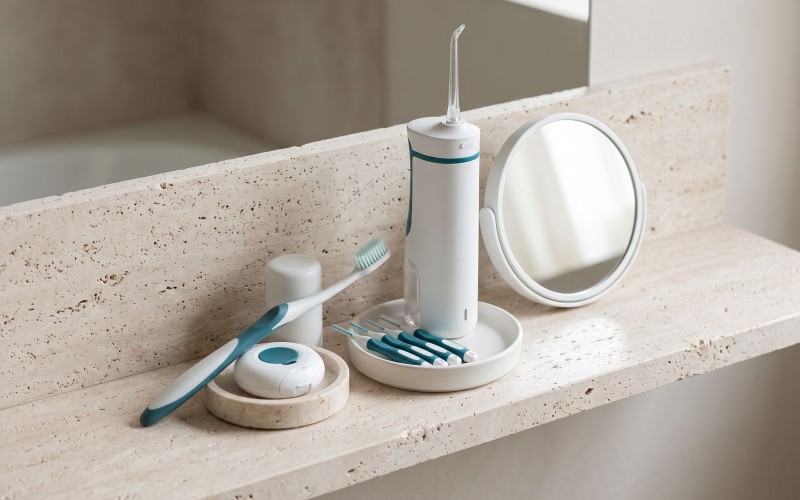
- Clean under the prosthesis with a water flosser, Super Floss or interdental brushes of the right size.
- Attend check-ups at the intervals your dentist sets; at these visits, the prosthesis is removed when needed and the area around the implants is professionally cleaned.
- If you clench your teeth, wear the protective night guard your dentist recommends.
At follow-up appointments, the tissues around the implants are measured, X-rays are taken at appropriate intervals, and the condition of the screws and prosthetic components is checked. These check-ups help small problems be noticed before they grow.
For practical tips, see the article how to care for dental implants.
What are the risks and points to keep in mind?
Swelling, bruising and tenderness lasting a few days are common after the procedure. Less often, infection, failure of one of the implants to fuse with the bone, fracture of prosthetic parts or screw loosening may occur. In the long term, the most important risk is inflammation around the implants due to inadequate cleaning; this is called peri-implantitis.
Smoking and uncontrolled diabetes can increase the risk of both problems during healing and peri-implant disease in the long term. For this reason, bringing these risk factors under control before and after treatment is recommended; you can find detailed information on the effects of smoking in the article on smoking and gum disease.
If you notice movement of the prosthesis, bleeding or swelling around the implants, a bad odor or discomfort while chewing, see your dentist. The course and results of treatment vary from person to person; a plan tailored to you is created after an examination and any necessary tests.