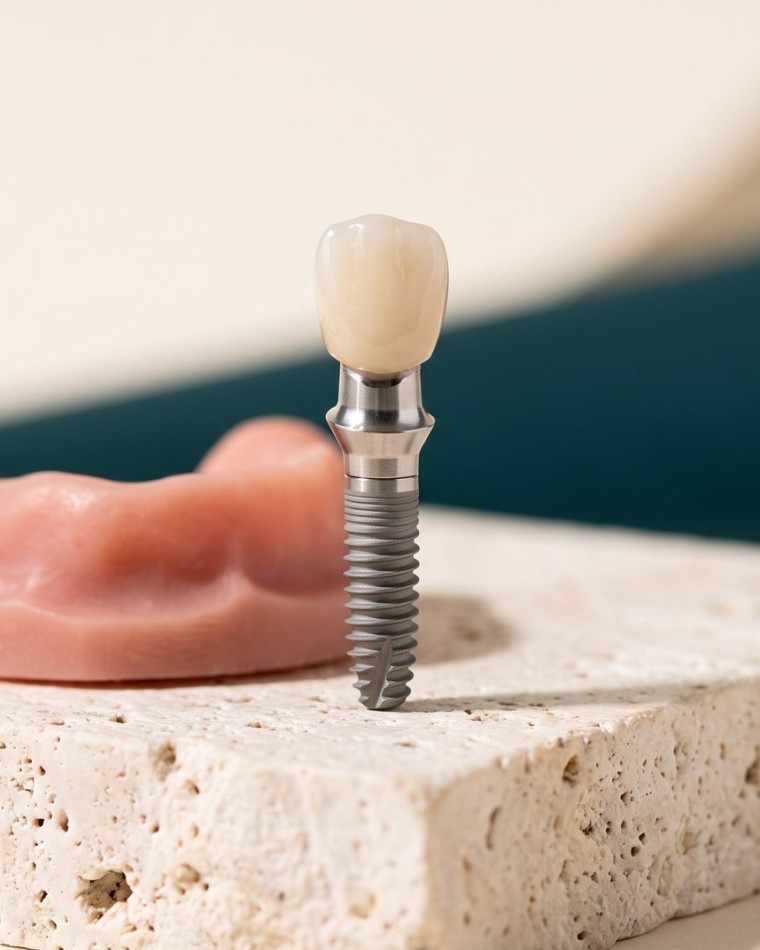
A dental implant is a screw-shaped artificial root, most often made of titanium, that is placed in the jawbone to replace the root of a lost tooth. Once it has fused with the bone, a crown, bridge or denture is attached on top. The long-term health of the treatment depends not only on careful planning but also on the health of the gum and bone tissue surrounding the implant.
What is a dental implant?
A dental implant is an artificial tooth root placed in the jawbone to replace a missing tooth. Implant treatment generally consists of three parts: the implant body, which stays within the bone; the abutment, which provides the connection at gum level; and the restoration visible in the mouth, that is, the crown or denture.
Most implants are made of titanium or titanium alloys; in some cases, zirconia implants may also be preferred. Because an implant-supported crown does not require the neighboring teeth to be cut down, it is considered an alternative to a bridge when a single tooth is missing. Which option is suitable is determined individually after an examination and any necessary tests.
Who are dental implants suitable for?
Implant treatment can be offered to adults who have lost one or more teeth and whose general health allows for a surgical procedure. The main uses are:
- A single missing tooth: a single crown, without touching the neighboring teeth.
- Several missing teeth: implant-supported bridges.
- No remaining teeth: implant-supported fixed or removable dentures. For details, see the All-on-4 and All-on-6 page.
- Patients who are not satisfied with how well their removable denture stays in place.
To be a candidate, jaw growth should be complete, there should be enough bone volume to support the implant, and any gum disease in the mouth should be under control. If bone volume is insufficient, additional procedures such as bone grafting and sinus lift may be planned.
Why do gum health and risk factors matter before an implant?
Gum health is the foundation of implant treatment. One of the most common causes of tooth loss is periodontitis, an advanced gum disease that destroys the tissues supporting the teeth. Research reports that peri-implant diseases may be more common in people with a history of periodontitis.
For this reason, the gum condition of the remaining teeth is evaluated before an implant is planned; if there is active disease, gum disease treatment is completed first. Periodontist Dr. Nadin Gemrekoğlu, DDS, PhD, treats gum and bone health as an integral part of implant planning.
Implants placed while untreated gum disease is present in the mouth are known to carry an increased risk of inflammation around the implant. If you notice bleeding gums, gum recession or loose teeth, these signs need to be evaluated before implant planning.
Smoking
Smoking has a negative effect on blood circulation and the immune response in the oral tissues. Studies have shown that smokers have a higher risk of problems while the implant fuses with the bone and of developing peri-implantitis later on. You can find more details in the article on smoking and gum disease. Quitting, or at least cutting down, during treatment is recommended.
Diabetes and other health conditions
Implants can be placed in people with well-controlled diabetes; uncontrolled diabetes, however, can delay wound healing and increase the risk of infection. Certain medications used to treat osteoporosis (for example, bisphosphonates and similar antiresorptive drugs), radiation therapy to the head and neck region, and clenching or grinding habits are also taken into account in planning. It is important to share all the medications you take and your health conditions during the examination; when needed, your other physicians are consulted.
How is implant treatment planned? What is the role of a 3D CBCT scan?
Planning starts with a clinical examination and a panoramic X-ray and, in most cases, is completed with cone beam computed tomography (a 3D CBCT scan). A 3D scan shows the height, width and density of the bone in three dimensions.
These images allow the position of important structures, such as the nerve canal in the lower jaw, the sinus cavity in the upper jaw and the roots of neighboring teeth, to be identified in advance. The size, angle and position of the implant are planned with the placement of the future tooth in mind. In some cases, surgical guides prepared with digital planning may be used.
The examination also evaluates oral hygiene, the bite, the teeth in the opposing jaw and the thickness of the gums. Having an adequate band of thick, attached gum tissue around the implant makes cleaning easier and supports the long-term health of the tissues; where needed, gum grafts may be planned before or during implant placement. The treatment plan, the expected course and alternative options are discussed with the patient in detail.
How is a dental implant placed? One-stage and two-stage approaches
Implant placement is performed under local anesthesia; the aim is for you not to feel pain during the procedure. The gum is opened, a site is prepared in the bone to the planned dimensions, and the implant is placed into it. The length of the procedure depends on the number of implants and any additional procedures.
- Two-stage approach: After the implant is placed, it is covered with gum tissue. After the healing period, the implant is uncovered with a minor procedure and a healing abutment that shapes the gum is attached.
- One-stage approach: At the first appointment, a healing cap that extends above the gum line is attached to the implant; a second surgical uncovering is not needed.
Which approach is chosen depends on bone quality, the initial stability of the implant, whether a graft is used and aesthetic expectations. In suitable cases, the implant can also be placed at the same appointment as the tooth extraction.
How long do healing and osseointegration take?
Osseointegration is the formation of a direct, functional connection between the implant surface and the surrounding bone. This process usually takes a few months; the time varies from person to person depending on bone quality, the area where the implant is placed and whether a graft was used.
During healing, temporary solutions may be used in visible areas. Once integration is complete, an impression or digital scan is taken and the final restoration is made. In some suitable cases, if the initial stability of the implant is sufficient, earlier placement of a temporary tooth may also be considered.
During the healing period, the condition of the tissues is monitored at follow-up appointments; stitches are removed at the time your dentist determines. Avoiding excessive load on the implant site and keeping the area clean during this time help integration progress well.
What should you pay attention to after implant treatment?
Mild swelling and tenderness are expected in the first few days after the procedure. Following these recommendations during this period supports healing:
- Apply cold compresses to the outside of your face at intervals during the first few hours.
- Choose lukewarm, soft foods for a few days; avoid chewing on the treated area.
- Do not smoke or drink alcohol.
- Use the medications and mouth rinses your dentist recommends exactly as directed.
- Clean the stitched area gently, following the instructions you are given.
In the long term, implants need daily care just like natural teeth. Along with brushing, using interdental brushes or a water flosser and attending regular check-ups are important. For practical tips, see the article how to care for dental implants.
What are the risks and possible side effects?
As with any surgical procedure, implant treatment carries some risks. Swelling, bruising and short-term tenderness after the procedure are common. Less often, infection, bleeding, altered sensation in nearby tissues, sinus-related problems in the upper jaw or failure of the implant to fuse with the bone may occur.
In the long term, the most important problem is inflammation of the tissues around the implant. If this progresses, it can lead to loss of the bone supporting the implant; details are explained on the peri-implantitis treatment page. If you notice bleeding, swelling, a bad odor or looseness around an implant, see your dentist.