
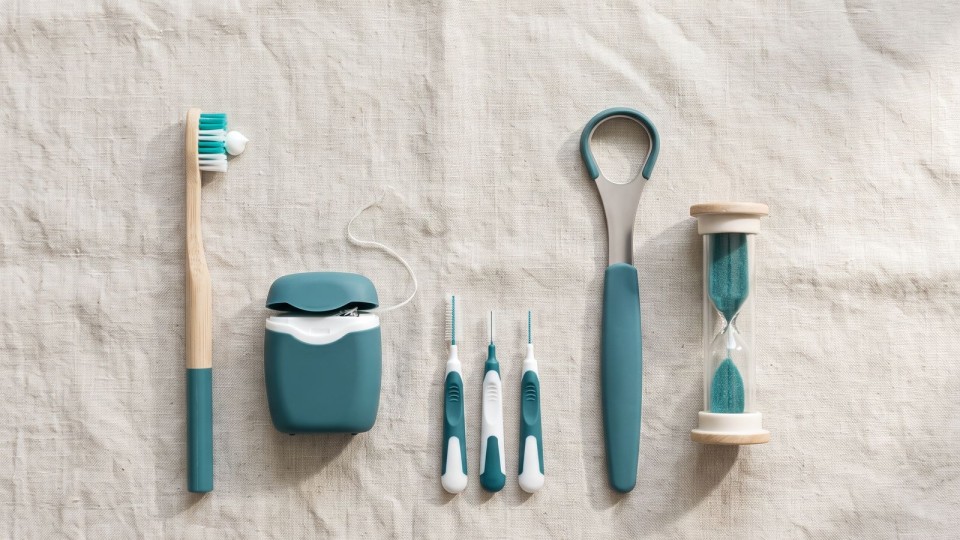
Proper oral care rests on two pillars: brushing your teeth twice a day with the right technique, and cleaning every day between the teeth where the brush cannot reach. A toothbrush on its own cannot adequately reach the surfaces of the teeth that face each other. In this guide, we explain the Bass technique step by step, and who floss, interdental brushes and water flossers are suitable for.
How often and for how long should you brush your teeth?
Teeth should be brushed at least twice a day, for about two minutes each time, with a fluoride toothpaste. Brushing at night before bed is especially important, because saliva flow decreases during sleep and the mouth's natural cleansing slows down.
- Choosing a brush: A brush with a small head and soft or medium bristles is suitable for most people. Hard bristles and pressing too hard can contribute to gum recession.
- Manual or electric? Both are effective when used correctly. Electric brushes can make things easier for people with limited manual dexterity or who struggle with technique.
- Toothpaste: A fluoride-containing toothpaste is recommended for adults. After brushing, spitting out the excess toothpaste and not rinsing your mouth with a lot of water helps the fluoride keep working.
- Replacing your brush: The brush should be replaced when the bristles splay or about every three months.
What is the Bass technique and how is it done?
The Bass technique is a brushing method in which the bristles are placed at a 45-degree angle to the gumline and small vibrating movements are used to clean plaque from the gingival sulcus. In the modified Bass technique, which is often recommended today, the brush is then swept toward the chewing surface of the tooth after this vibrating movement. Studies have reported that the modified Bass technique removes plaque at the gum margin more effectively than people's usual brushing habits.
- Place the brush against the tooth surface at a 45-degree angle, with the bristles facing the line where the tooth meets the gum.
- With light pressure, let the tips of the bristles slip gently into the gingival sulcus.
- Without moving the brush from its position, make very short back-and-forth vibrating movements.
- Then sweep the brush from the gum toward the tip of the tooth.
- Move the brush to the next area of two or three teeth and repeat, overlapping slightly.
- On the inner surfaces of the front teeth, hold the brush vertically and make the same movement; clean the chewing surfaces with back-and-forth strokes.
Starting from the same point each time and moving in a set order prevents some areas from being skipped. For people with gum recession, it is recommended that the technique be adapted individually together with the dentist; you can read our article Gum Recession: Signs and Causes on this topic.
Why is cleaning between the teeth (interdental cleaning) necessary?
Interdental cleaning is necessary because a toothbrush cannot adequately reach the surfaces of the teeth that face each other, and gum disease most often begins in these areas. Plaque that builds up between the teeth can harden over time into tartar and set the stage for gum inflammation.
Interdental cleaning is recommended once a day. Doing it before brushing can help the fluoride in the toothpaste reach between the teeth as well. Hardened tartar, however, cannot be removed with a brush or floss; it needs to be removed professionally with scaling and root planing.
Floss or interdental brush?
Which tool is suitable depends on the width of the space between the teeth: an interdental brush is generally preferred for spaces it fits into, and floss for narrow spaces where a brush will not fit.
Interdental brush
Interdental brushes are effective at removing plaque, especially in people who have been treated for gum disease, who have gum recession, or whose interdental spaces have opened up. An important advantage is that they can adapt to the grooves on root surfaces. The right size is one that enters the space without forcing and touches the tooth surfaces. Most people need two or three different sizes for the different spaces in their mouth. Without bending the wire, move the brush horizontally back and forth a few times at the level of the gum.
Dental floss
Floss is suitable for narrow spaces where the teeth are in tight contact. Take about 40 cm (16 inches) of floss, wind it around your fingers and gently ease it into the space between the teeth with a sawing motion. Wrap the floss around the tooth surface in a "C" shape, bring it down to just below the gingival sulcus and clean with an up-and-down motion. Avoid snapping the floss hard against the gum.
Deciding together with your dentist at a check-up appointment which tool and which size to use for each space will help you make the right choice.
Can a water flosser replace dental floss?
A water flosser does not replace floss and interdental brushes; however, in some situations it can be useful as an additional tool. It removes food debris between the teeth and at the gum margin with pressurized water, but on its own it may not adequately clean plaque that is stuck to the tooth surface.
A water flosser may be recommended as a supplement, especially for:
- People undergoing fixed orthodontic treatment (braces),
- People with bridges or fixed implant-supported prostheses,
- People who find it difficult to use floss because of limited manual dexterity.
Detailed recommendations for people with implants can be found in our article Dental Implant Care.
In the evening, first clean between your teeth with an interdental brush or floss. Then brush for about two minutes using the modified Bass technique. Spit out the excess toothpaste and do not rinse your mouth with a lot of water. In the morning, brush again using the same technique.
What are the most common brushing mistakes?
The most common mistakes are pressing too hard with the brush, brushing for too short a time and regularly skipping certain surfaces. Other points to watch for include:
- "Scrubbing" the teeth with hard, horizontal movements,
- Using a brush with hard bristles,
- Always starting in the same area and skipping the inner surfaces and the teeth at the very back,
- Stopping brushing an area when the gums bleed,
- Brushing immediately after acidic foods and drinks; waiting a while helps protect the tooth enamel.
Bleeding gums are usually a sign that plaque has built up in that area; rather than stopping brushing, it is recommended to continue gentle, regular cleaning. For the possible causes of bleeding, see our article Why Do Gums Bleed?
When should you see a dentist?
See your dentist if any of the following occurs despite regular and proper care:
- Gum bleeding during brushing or interdental cleaning that has lasted for one to two weeks,
- Redness, swelling or tenderness of the gums,
- Teeth that look longer or increased sensitivity to cold,
- Persistent bad breath,
- Loose teeth or new gaps opening between the teeth,
- Hard deposits on the tooth surfaces that cannot be removed by brushing.
During an examination with periodontist Dr. Nadin Gemrekoğlu, DDS, PhD, the cleaning tools and technique suited to your mouth are assessed individually. To make an appointment, you can use our contact page.